Tampilkan postingan dengan label certification. Tampilkan semua postingan

Rabu, 08 Desember 2010

Cisco Certified Voice Professional (CCVP)


I see there are a lot of materials in my office now to learn about Voice-Over-IP solutions. In addition, my first task now is to help a team that develops Advanced Technology Demo Units Voice and Unified Communications plus Cisco IP Interoperability and Collaboration System (IPICS). Besides, one of my team just finished her Bachelor's Thesis about IP Telephony and Cisco Unified Communications Manager (CallManager), maybe she can explain or teach me something regarding to IP Telephony.
Then, my friend told me that maybe I should take CCVP rather than CCNP since the condition and environment of my office can support me in pursuing CCVP.
The CCVP (Cisco Certified Voice Professional) validates a network professional's ability to implement and operate Cisco Unified Communications solutions in single site and multi-site deployments. Individuals who hold a CCVP certification can help create an IP telephony solution that is transparent, scalable, and manageable. The CCVP curriculum focuses on Cisco Unified CallManager, voice gateways and gatekeepers, switches, Unified IP Phones, and skills to secure the voice communications and ensure voice quality of service. Candidates must pass five secure, proctored certification-quality exams to become a Cisco Certified Voice Professional (CCVP). The prerequisite for the Cisco Certified Voice Professional (CCVP) is CCNA. As voice technologies continue to grow in importance Cisco helps you keep pace with a rapidly changing world.

The CCVP provides network professionals with the knowledge, skills, and credentials necessary
to design and implement end-to-end Cisco IP Telephony solutions. The certification content focuses on Cisco Call Manager, QoS, gateways, gatekeepers, IP phones, voice applications and utilities on Cisco routers and Catalyst switches..

Required Exam(s)
Recommended Training
642-642 QoS Quality of Service (QoS)
642-432 CVOICE Cisco Voice over IP (CVOICE)
AND
Cisco Voice over IP Fundamentals (CVF)
642-426 TUC Troubleshooting Cisco Unified Communications Systems (TUC)
642-444 CIPT 4.1


OR


642-445 CIPT 5.0
Cisco IP Telephony Part 1 (CIPT1 4.1)
AND
Cisco IP Telephony Part 2 (CIPT2 4.1)

OR

Cisco IP Telephony Part 1 (CIPT1 5.0)
AND
Cisco IP Telephony Part 2 (CIPT2 5.0)
642-453 GWGK Implementing Cisco Voice Gateways and Gatekeepers (GWGK)

So the steps that I should take are Cisco Voice Fundamentals, a 6-hour e-learning course to establish a strong foundation in VoIP and PSTN fundamentals, then CVOICE, followed by CIPT1, GWGK, or QoS in any order. CIPT2 should be completed only after completing CIPT1.

The final course in the series, IP Telephony Troubleshooting is best taken after having completed the other CCVP courses in the curriculum. Those will help me better understand how to install, configure and deploy the various voice products and technologies tested in the CCVP exams.

From the information that I got, there will be 5 exams to pass:
  • CVOICE is the foundation for it all (the most useful exam)
  • QoS is not much based on anything; but you need to have some background so it is better after CVOICE (the most interesting one)
  • GWGK is CVOICE2 (the hardest to master)
  • TUC has some parts built on CIPT knowledge (the easiest to do)
  • CIPT is a lot better after GWGK (the most boring)
I will think about CCVP and CCNP, which one should I choose for now...

Jumat, 02 Oktober 2009

CCNA Discovery 3 - FINAL Exam Answers V.4 #26-30

26. Which command should a network administrator issue to disable default summarization in an EIGRP network?
• Router(config-router)# null 0 route
• Router(config-if)# no ip summary-address
• Router(config-router)# no ip summary-address
• Router(config-if)# no auto-summary
• Router(config-router)# no auto-summary

27.
3
Refer to the exhibit. Users on the 172.30.20.0/24 network are unable to access any of the servers located on the 192.168.0.0/23 network. Given the network topology and OSPF configuration, what two problems exist in this network? (Choose two.)
• There is a routing loop occurring between all three routers.
• There is a network statement missing.
• Network 172.30.20.0 has an incorrect wildcard mask.

• The OSPF Area configuration is incorrect.
• /23 is an invalid subnet mask for the 192.168.0.0 network.

28.
11
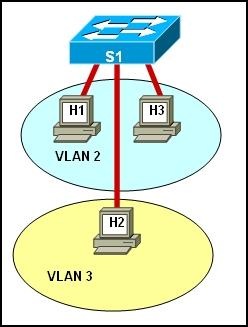
Refer to the exhibit. Which IP addressing scheme would be correct for the network?
• H1-172.18.0.10/16
H2-172.18.0.11/16
H3-172.18.0.12/16
• H1-172.18.0.10/16
H2-172.19.0.10/16
H3-172.18.0.11/16

• H1-172.18.0.10/16
H2-172.18.0.11/16
H3-172.19.0.11/16
• H1-172.18.0.10/16
H2-172.19.0.11/16
H3-172.19.0.11/16

29.
14
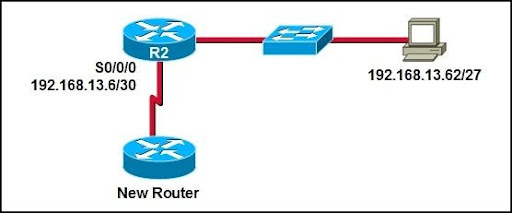
Refer to the exhibit. An administrator is adding a new router to the network. The IP address 192.168.13.6/30 has been assigned to the connecting serial interface on R2. What IP address must the administrator assign to the serial interface of the new router?
• 192.168.13.4/30
• 192.168.13.5/30
• 192.168.13.7/30
• 192.168.13.58/30
• 192.168.13.61/27
• 192.168.13.63/27

30. After comparing a previous baseline to current network statistics, the network engineer has discovered a significant increase in unwarranted traffic to the extranet. Which two steps simplify administration and control the unwanted traffic? (Choose two.)
• define an ACL at the distribution layer to isolate packets
• add an ACL at the router in the enterprise edge to block the traffic

• deploy a Layer 3 switch to contain broadcasts
• connect remote locations directly to the intranet
• configure all hosts with the same default gateway to eliminate unnecessary broadcasts
• deploy one core ISP router to reduce the delay in path determination

Kamis, 04 Juni 2009

CCNA Discovery 3 - Module 1 Exam Answers Version 4.0

1. What can be found at the enterprise edge?
• Internet, VPN, and WAN modules
• Internet, PSTN, and WAN services
• server farms and network management
• campus infrastructure, including access layer devices

2. In which functional area of the Cisco Enterprise Architecture should IDS and IPS be located to detect
• and prevent services from accessing hosts?
• Enterprise Campus
• Edge Distribution
• Enterprise Edge
• Service Provider Edge

3. A business consultant must use Internet websites to research a report on the e-business strategies of several firms and then electronically deliver the report to a group of clients in cities throughout the world. Which two teleworker tools can the consultant use to accomplish this project? (Choose two.)
• VoIP
• VPN
• HTTP
• Telnet
• email

4. Which two measures help ensure that a hardware problem does not cause an outage in an enterprise LAN that supports mission critical services? (Choose two.)
• providing failover capability
• installing redundant power supplies

• purchasing more bandwidth from the ISP
• implementing broadcast containment with VLANs
• installing routers that can handle a greater amount of throughput

5. Which task would typically only require services located at the access layer of the hierarchical design model?
• connecting to the corporate web server to update sales figures
• using a VPN from home to send data to the main office servers
• printing a meeting agenda on a local departmental network printer
• placing a VoIP call to a business associate in another country
• responding to an e-mail from a co-worker in another department

6. How does a VPN work to support remote user productivity?
• It uses SSL to encrypt remote user logins to the corporate intranet.
• It uses secure Telnet for remote user connections to internal network devices.
• It creates a virtual circuit that allows real-time communications between any two Internet endpoints.
• It uses encapsulation to create a secure tunnel for transmission of data across non-secure networks.****

7. A remote user needs to access a networking device on the internal network of the company. The transactions between the remote user and the device must be secure. Which protocol enables this to happen securely?
• HTTP
• SSH
• Telnet
• FTP

8. What does VoIP provide to telecommuters?
• high-quality, live-video presentations
• real-time voice communications over the Internet
• ability to share desktop applications simultaneously
• secure, encrypted data transmissions through the Internet

9. Which functional component of the Cisco Enterprise Architecture is responsible for hosting internal servers?
• enterprise campus
• enterprise edge
• service provider edge
• building distribution

10. What is the purpose of the Cisco Enterprise Architecture?
• remove the three-layer hierarchical model and use a flat network approach
• divide the network into functional components while still maintaining the concept of Core, Distribution, and Access Layers
• provide services and functionality to the core layer by grouping various components into a single
• component located in the access layer
• reduce overall network traffic by grouping server farms, the management server, corporate intranet, and e-commerce routers in the same layer

11. Which two solutions would an enterprise IT department use to facilitate secure intranet access for remote workers? (Choose two.)
• VPN
• NAT
• user authentication
• client firewall software
• packet sniffing

12. Which statement describes the difference between an enterprise WAN and an enterprise extranet?
• An enterprise WAN is designed to interconnect local LANs, while an enterprise extranet is designed to interconnect remote branch offices.
• An enterprise WAN is designed to interconnect branch offices, while an enterprise extranet is designed to give access to external business partners.
• An enterprise WAN is designed to provide remote access for its teleworkers, while an enterprise extranet is designed to provide Internet connectivity for the enterprise.
• An enterprise WAN is designed to provide Internet connectivity for the enterprise, while an enterprise extranet is designed to provide remote access to the enterprise network for teleworkers.

13. Why would a network administrator want to limit the size of failure domains when designing a network?
• reduces the effect of Ethernet collisions
• reduces the impact of a key device or service failure
• reduces the impact of Internet congestion on critical traffic
• reduces the impact of blocking broadcast packets at the edge of the local network

14. What is the main purpose of the Access Layer in a hierarchically designed network?
• performs routing and packet manipulation
• supplies redundancy and failover protection
• provides a high-speed, low-latency backbone
• serves as a network connection point for end-user devices

15. Which three functions are performed at the Distribution Layer of the hierarchical network model? (Choose three.)
• forwards traffic that is destined for other networks
• isolates network problems to prevent them from affecting the Core Layer

• allows end users to access the local network
• provides a connection point for separate local networks
• transports large amounts of data between different geographic sites
• forwards traffic to other hosts on the same logical network

16. What is a benefit of having an extranet?
• It provides web-like access to company information for employees only.
• It limits access to corporate information to secure VPN or remote access connections only.
• It allows customers and partners to access company information by connecting to a public web server.
• It allows suppliers and contractors to access confidential internal information using controlled external connections.

17. What are two important characteristics or functions of devices at the Enterprise Edge? (Choose two.)
• providing Internet, telephone, and WAN services to the enterprise network
• providing a connection point for end-user devices to the enterprise network
• providing high-speed backbone connectivity with redundant connections
• providing intrusion detection and intrusion prevention to protect the network against malicious activity
• providing packet inspection to determine if incoming packets should be allowed on the enterprise network


18. Why is TCP the preferred Layer 4 protocol for transmitting data files?
• TCP is more reliable than UDP because it requires lost packets to be retransmitted.
• TCP requires less processing by the source and destination hosts than UDP.
• UDP introduces delays that degrade the quality of the data applications.
• TCP ensures fast delivery because it does not require sequencing or acknowlegements.

19. The ABC Corporation implements the network for its new headquarters using the Cisco Enterprise Architecture. The network administrator wants to filter the traffic from and to the outside world. Where should the administrator deploy a firewall device?
• server farm
• enterprise edge
• enterprise campus
• service provider edge

20. Which two statements are reasons why UDP is used for voice and video traffic instead of TCP?(Choose two.)
• TCP requires all data packets to be delivered for the data to be usable.
• The acknowledgment process of TCP introduces delays that break the streams of data.
• UDP does not have mechanisms for retransmitting lost packets.

• UDP tolerates delays and compensates for them.
• TCP is a connectionless protocol that provides end-to-end reliability.
• UDP is a connection-oriented protocol that provides end-to-end reliability.

Rabu, 25 Februari 2009

CCNA Certification

CCNA Certification


The CCNA certification (Cisco Certified Network Associate) is Cisco’s foundation-level networking certification. Upon completion, CCNA candidates should be able to successfully carry out any number of essential networking maintenance and troubleshooting duties such as installing, configuring and operating LAN, WAN and dial access services for small networks, as well as having good working knowledge of protocols such as IP, IGRP, Serial, Frame Relay, IP RIP, VLAN’s, Ethernet and Access Lists.
While there are no pre-requisites for the CCNA certification, the CCNA should not be regarded as a pure entry-level networking certification. Indeed, the CCNA certification is targeted more toward those with intermediate networking experience and knowledge. Those with little or no prior experience should perhaps consider an entry-level networking certification (such as CompTIA’s Network+) as a stepping stone to the CCNA certification.

The CCNA itself is a prerequisite to more advanced Cisco certifications, such as the CCNP, CCSP and the CCIE, meaning that candidates wishing to go on to the more advanced Cisco certifications first need to successfully pass the CCNA.

Candidates have the option of two routes toward CCNA certification. Either take and pass two individual exams or alternatively, one larger, combined exam. The exam options are (click the respective links to be taken to the applicable Cisco web page):

Combined exam:

640-801 CCNA - 90 minutes, 55-65 questions

Or

Individual exams:

640-821 INTRO - 75 minutes, 45-55 questions
640-811 ICND - 60 minutes, 40-50 questions

Although the candidate will be tested on the same subjects irrespective of which exam route they take, the two different options offer candidates a degree of flexibility in the manner in which they choose to study for the CCNA certification. By taking the individual exam route, candidates can focus on one subject area at a time and then take the relevant exam when they feel ready. Additionally, the two-exam approach gives the candidate the opportunity to ease into the certification by taking the 640-821 INTRO exam first (which is not as advanced in subject detail as the 640-811 ICND exam). Alternatively, by taking the 640-801 CCNA combined exam, candidates can attempt to gain the entire CCNA certification credential in one fell swoop.

Candidates who choose the two-exam route have three years to finish both exams in order to become CCNA qualified, and the certification itself is valid for three years (after which time recertification is required to remain CCNA certified. Additionally, candidates who opt for the two-exam approach should keep in mind that there is a fee for each exam which makes the two-exam approach slightly more expensive than the one-exam route.

To recertify, a candidate must pass either the applicable current CCNA exam, the ICND exam, or any of the ‘642’ professional level or Cisco Specialist exams. Alternatively, a CCNA candidate can pass any current CCIE written exam to stay CCNA qualified.

Candidates who successfully pass the 640-801 CCNA exam will immediately gain the CCNA certified credential, while candidates who opt for the two-exam route must pass both exams before being awarded the CCNA certification. Score marks and section feedback will be provided to candidates at the conclusion of each exam. It is important that you keep your score report safe as you will need this with any future correspondence with Cisco concerning your qualification.

On the following pages you’ll find plenty of links to free CCNA self study resources around the net, such as practice exams, CCNA forums, study guides and much more. Be sure to regularly check the official CCNA certification home page to keep up with the latest exam requirements, particularly to check for updated topics covered in the exams.

CCNA Certification information


Some background information on the CCNA certification to get you started:

CCNA certification Cisco CCNA home page
CertMag's CCNA preparation guide How to best prepare for the CCNA certification
CCNA FAQ's Support and CCNA certification FAQ's
http://wiley.com - CCNA certification exam information
Cisco's SubMag Cisco's submag - need to register to receive


Free CCNA study guides
Free CCNA practice tests

Cisco Certifications

Cisco Certifications

The respective Cisco certification links below will take you various resources for each of the certification tracks. As well as general information for each of the Cisco certifications, you'll find links to free study guides, practice tests and much, much more. While we try to keep the information as up-to-date as possible, you should always refer to the official Cisco website for the latest information on any particular Cisco certification track that you are working on.


Technician Level (entry-level)
CCENT - Cisco Certified Entry Networking Technician
Associate Level (intermediate-level)
CCDA - Cisco Certified Design Associate
CCNA - Cisco Certified Network Associate
Professional Level (advanced)
CCDP - Cisco Certified Design Professional
CCIP - Cisco Certified Internetwork Professional
CCNP - Cisco Certified Network Professional
CCSP - Cisco Certified Security Professional
CCVP - Cisco Certified Voice Professional
Expert Level
CCIE - Cisco Certified Internetwork Expert
Free Router Simulators

Senin, 15 Desember 2008

Introduction: Overview of Certification and How to Succeed


Professional certifications have been an important part of the computing industry for many years and will continue to become more and more important. Many reasons exist for these certifications, but the most popularly cited reason is that of credibility. All other considerations held equal, the certified employee/consultant/job candidate is considered more valuable than one who is not.
Cisco Certifications: Training Paths and Exams
The Cisco Certified Internetwork Expert (CCIE) certification program has been available since the early ’90s. This  long-standing certification has maintained a high degree of credibility and is recognized as a certification that lives up to the name “expert.” The CCIE certification process requires passing a computer based test and then a two-day hands-on lab. Recertification is required every two years to ensure that the individual has kept skills up-to-date. Many problems were created by having one highly credible, but difficult to pass, certification. One problem was that there was no way to distinguish between someone who is almost ready to pass CCIE and a novice. The CCIE lab test is meant to prove that the individual not only has mastery of many topics, but the ability to learn and unravel situations quickly and under pressure. Many highly respected engineers have failed the CCIE lab on the first try. Employers wanting to reward employees based on certification, employers looking at prospective new employees, and network managers trying to choose between competing consulting companies have had too few Cisco-related certifications on which they could base their decisions.
In an effort to solve these problems, Cisco Systems has created several new “Cisco Career Certifications.” Included in these new certifications is a series of certifications related to routing and switching. The Cisco Certified Network Associate (CCNA) certification, accomplished by passing a computer-based exam, is one of these new certifications oriented toward routing and switching. CCNA is the first certification in this series. If you understand the protocols listed in the table of contents, plus how they apply to the network diagramed in Figure I–1, then you are a candidate who should be ready for the CCNA exam.