Tampilkan postingan dengan label question. Tampilkan semua postingan

Minggu, 27 Juni 2010

Cisco Netacad CCNA 4 Final

Which of the following are primary functions of a router? (Choose two.)
 
packet switching
microsegmentation
domain name resolution
path selection
flow control
A network administrator is in charge of two separate networks that share a single building. What device will be required to connect the two networks and add a common connection to the Internet that can be shared?
 
hub
router
access point
Ethernet switch
A router boots and enters setup mode. What is the reason for this?
 
The IOS image is corrupt.
Cisco IOS is missing from flash memory.
The configuration file is missing from NVRAM.
The POST process has detected hardware failure.

Refer to the exhibit. A network administrator adds this command to router R1: ip route 192.168.2.0 255.255.255.0 S0/0/0. What is the result of adding this command?
This route is automatically propagated throughout the network.
The traffic for network 172.16.1.0 is forwarded to network 192.168.2.0.
A static route is established.
The traffic for all Class C networks is forwarded to 172.16.1.2.
In a complex lab test environment, a router has discovered four paths to 192.168.1.0/24 via the use of the RIP routing process. Which route will be installed in the routing table after the discovery of all four paths?
 
R 192.168.1.0/24 [120/3] via 192.168.110.1, 00:00:17, Serial0/1/0
R 192.168.1.0/24 [120/2] via 192.168.200.1, 00:00:17, Serial0/0/0
R 192.168.1.0/24 [120/1] via 192.168.100.1, 00:00:17, Serial0/0/1
R 192.168.1.0/24 [120/4] via 192.168.101.1, 00:00:17, Serial0/1/1
Which three statements are true regarding the encapsulation and de-encapsulation of packets when traveling through a router? (Choose three.)
 
The router modifies the TTL field, decrementing it by one.
The router changes the source IP to the IP of the exit interface.
The router maintains the same source and destination IP.
The router changes the source physical address to the physical address of the exit interface.
The router changes the destination IP to the IP of the exit interface.
The router sends the packet out all other interfaces, besides the one it entered the router on.


Refer to the exhibit. Router R1 receives a packet for destination 192.168.1.10. Which route will be preferred for this packet?
 
through the Fa0/0 interface
through the Fa0/1 interface
through the S0/0/0 interface
through the S0/0/1 interface


Refer to the exhibit. Which two routes are level 1 ultimate routes? (Choose two.)
 
10.0.0.0
10.1.2.0
10.2.2.0
10.1.1.0
192.168.1.0
192.168.2.0
Which routing protocol by default uses bandwidth and delay to calculate the metric of a route?
 
RIPv1
RIPv2
OSPF
EIGRP
Which statement is true about the metrics used by routing protocols?
 
A metric is a value used by a particular routing protocol to compare paths to remote networks.
A common metric is used by all routing protocols.
The metric with the highest value is installed in the routing table.
The router may use only one parameter at a time to calculate the metric.


Refer to the exhibit. A router learns a route to the 192.168.6.0 network, as shown in the output of the show ip rip database command. However, upon running the show ip route command, the network administrator sees that the router has installed a different route to the 192.168.6.0 network learned via EIGRP. What could be the reason for the missing RIP route?
 
Compared to RIP, EIGRP has a lower administrative distance.
Compared to EIGRP, RIP has a higher metric value for the route.
Compared to RIP, the EIGRP route has fewer hops.
Compared to RIP, EIGRP has a faster update timer.

Refer to the exhibit. RIPv1 has been used as a routing protocol on the network. A new 172.16.2.0/24 network has been added on router R2 and configured under the RIP routing process. When will R1 converge?
after 13 seconds
after 30 seconds
after 180 seconds
after R1 receives triggered updates from R2
Which two statements are true for link-state routing protocols? (Choose two.)
 
Routers that run a link-state protocol can establish a complete topology of the network.
Routers in a multipoint network that run a link-state protocol can exchange routing tables.
Routers use only hop count for routing decisions.
The shortest path first algorithm is used.
Split horizon is used to avoid routing loops.
An administrator is configuring Router1 so that it can connect to Router2 by using IP. Which protocol can be used by Router1 to determine the IP address of Router2 when they are directly connected and only Layer 2 connectivity exists between them?
 
ARP
CDP
ICMP
Telnet

Refer to the exhibit. A device is required to complete the connection between router R1 and the WAN. Which two devices can be used for this? (Choose two.)
a CSU/DSU device
a modem
an Ethernet switch
a hub
a bridge


What can be determined from the output shown in the exhibit? (Choose two.)
 
Annapolis is a 2611 router that is connected to the S0/0 interface of the Montgomery router.
All of the routers are connected to Montgomery through an Ethernet switch.
Montgomery has Layer 2 connectivity with Cumberland.
Layer 3 connectivity is operational for all of the devices listed in the Device ID column.
An administrator consoled into the Waldorf router can ping the Brant router.
Brant, Fisherman, and Potomac are directly connected to Montgomery.


Refer to the exhibit. Which route in the routing table of R1 will be discarded by its neighboring router?
 
192.168.2.0
192.168.3.0
192.168.4.0
192.168.9.0
192.168.10.0
192.168.11.0

Refer to the exhibit. Based on the partial output in the exhibit, why can users establish a console connection to this router without entering a password?
The login command was not entered on the console line.
The enable password should be an enable secret password.
No username and password combination has been configured.
Console connections cannot be configured to require users to provide passwords.

Refer to the exhibit. An administrator is attempting to configure a router by copying and pasting the commands that are shown in the exhibit. However, only one of the FastEthernet interfaces is coming up. What is the problem?
Both interfaces are in the same IP subnet.
FastEthernet0/1 does not have a description.
There can be only one FastEthernet interface enabled on a router at one time.
The administrator did not exit to global configuration mode before configuring FastEthernet0/1.


Refer to the exhibit. The network administrator has run the following command on R1.

R1(config)# ip route 192.168.2.0 255.255.255.0 172.16.1.2

What is the result of running this command?
 
Traffic for network 192.168.2.0 is forwarded to 172.16.1.2.
This route is automatically propagated throughout the entire network.
Traffic for all networks is forwarded to 172.16.1.2.
The command invokes a dynamic routing protocol for 192.168.2.0.

Refer to the exhibit. The command ip route 0.0.0.0 0.0.0.0 S0/0/0 is run on router R2. What are the two results of this command? (Choose two.)
A static route will be updated in the routing table.
The traffic from the Internet will be directed to R2.
The traffic from the source network 172.16.0.0/22 will be blocked.
The route will be specified as the default route for all networks not defined in the routing table.
All the broadcasts will be forwarded via the S0/0/0 interface of R2.

Refer to the exhibit. All routers are running the same routing protocol. Based on the exhibit and its displayed commands, which statement is true?
The wildcard mask is incorrectly configured.
A default route must be configured on every router.
Routers B, C, and D have no access to the Internet.
The link to the ISP is not advertised by the routing protocol process.
The command ip route 192.168.2.0 255.255.255.0 172.16.2.2 was entered into the router. After network changes were made, the new next hop for the 192.168.2.0/24 network is 172.16.5.1. What should an administrator do so that the router will use the new next hop to reach the 192.168.2.0 network?
 
Enter the command clear ip route *.
Lower the administrative distance for the new path to ensure that it is used first.
Negate the original command and enter a new static route with the new next hop.
Nothing. The router will learn of the new next hop and automatically update the route table.

Refer to the exhibit. On the basis of the show running-config output, which option correctly reflects the routes that will be listed in the R2 routing table?


Refer to the exhibit. Routers 1 and 2 are directly connected over a serial link. Pings are failing between the two routers. What change by the administrator will correct the problem?
 
Set the encapsulation on both routers to PPP.
Decrease the bandwidth on Serial 0/1/0 on router 2 to 1544.
Change the cable that connects the routers to a crossover cable.
Change the IP address on Serial 0/1/0 on router 2 to 192.168.0.1/30.

Refer to the exhibit. Which combination of network ID and subnet mask can be used to meet the 24 host requirement of the LAN that is attached to Router3?
192.168.0.0/27
192.168.0.64/26
192.168.0.192/26
192.168.0.192/27


Refer to the exhibit. The networks that are connected to R1 have been summarized for R2 as 192.168.136.0/21. Which packet destination address will R2 forward to R1?
 
192.168.135.1
192.168.142.1
192.168.144.1
192.168.128.1
A network administrator has been asked to configure a network using a classful IP addressing scheme. Which statement is true about the IP addressing that will be used?
Classful IP addresses can be used only when static routing is configured in the network.
Classful IP addresses allow the network/host boundary to occur at any bit in the 32-bit address.
The subnet mask for classful IP addresses can be determined by the value of the first octet of the IP address.
Classful IP addresses require the subnet mask to be included in the routing updates that are propagated by the classful routing protocols.

Which range of IP addresses will be used by RIPv2, EIGRP, and OSPF routing protocols to send routing advertisements?


How will a router that is configured with a classless routing protocol determine the subnet mask that should be assigned to routes that are learned from neighboring classless routers?
 
The subnet mask that is included in the routing updates will be used.
The subnet mask of the interface that receives the update will be used.
The subnet mask that is specified in the network command will be used.
The class of the network in the update will determine the subnet mask that is used.

Refer to the exhibit. Both routers are using the RIPv2 routing protocol and static routes are undefined. R1 can ping 192.168.2.1 and 10.1.1.2, but is unable to ping 192.168.4.1.

What is the reason for the ping failure?
The serial interface between two routers is down.
R2 is not forwarding the routing updates.
The 192.168.4.0 network is not included in the RIP configuration of R2.
RIPv1 needs to be configured.

Refer to the exhibit. When troubleshooting a network, it is important to interpret the output of various router commands. On the basis of the exhibit, which three statements are true? (Choose three.)
The missing information for Blank 1 is the command show ip route.
The missing information for Blank 1 is the command debug ip route.
The missing information for Blank 2 is the number 100.
The missing information for Blank 2 is the number 120.
The missing information for Blank 3 is the letter R.
The missing information for Blank 3 is the letter C.

Refer to the exhibit. The network is using the RIPv2 routing protocol. If network 10.0.0.0 goes down, what mechanism will prevent Router1 from advertising false routing information back to Router2?
triggered updates
poison reverse
holddown timers
split horizon
How does route poisoning prevent routing loops?
 
New routing updates are ignored until the network has converged.
Failed routes are advertised with a metric of infinity.
A route is marked as unavailable when its Time to Live is exceeded.
The unreachable route is cleared from the routing table after the invalid timer expires.


Refer to the exhibit. R1 and R2 are both configured with RIPv1. Beginning from global configuration mode, what comand or commands will eliminate RIP updates on the Ethernet segment of R2?
 
R2# configure terminal
R2(config)# router rip
R2(config-router)# passive-interface FastEthernet0/0
R2# configure terminal
R2(config)# passive-interface FastEthernet0/0
R2# passive-interface FastEthernet0/0
R2# configure terminal
R2(config)# interface FastEthernet0/0
R2(config-if)# passive-interface FastEthernet0/0

Refer to the exhibit. All routers are configured with RIPv2 active on all interfaces. Automatic summarization is in effect. Why does the routing table on R3 include the 209.165.200.228/30 network but not the 172.30.1.0/24 and 172.30.2.0/24 networks?
CIDR is required to route supernets.
There is no default gateway configured.
The 172.30.0.0/16 subnets are discontiguous.
RIPv2 cannot route networks with variable subnets.

Refer to the exhibit. The routers in the exhibit are running the EIGRP routing protocol. What statement is true regarding how packets will travel from the 172.16.1.0/16 network to the 192.168.200.0/24 network?
The router chooses the first path that it learned and installs only that route in the routing table.
The router chooses the path with the lowest administrative distance and installs only that route in the routing table.
The router chooses the highest routing ID based on the advertised network IP addresses and installs only that route in the routing table.
The router installs all the equal cost paths in the routing table but sends packets out only one, holding the others in reserve in case the primary route goes down.
The router installs all the equal cost paths in the routing table and performs equal cost load balancing to send packets out multiple exit interfaces.

Refer to the exhibit. Which two statements are true based on the exhibited output? (Choose two.)
All routes are stable.
Each route has one feasible successor.
The serial interface between the two routers is down.
The administrative distance of EIGRP has been set to 50.
The show ip eigrp topology command has been run on R1.

Refer to the exhibit. Host A is having problems accessing server A. All routers have the same EIGRP configuration as router RTR_A. What should be done so that host A can access server A?
Add the command no auto-summary on all routers.
Change the network statements to include a wildcard mask.
Adjust the EIGRP hello timers to account for the network delay.
Add the command eigrp log-neighbor-changes on all routers.
When would the network administrator use the ip bandwidth-percent eigrp as-number percent command?
 
when there is a low bandwidth connection
when the connection is on a shared medium
when the connection is serial instead of Ethernet
when the link is always busy

Refer to the exhibit. What information can be determined from the displayed output?
EIGRP packets are waiting to be sent to the neighbors.
The adjacencies between the routers are yet to be established.
The IP address 192.168.10.10 is configured at serial interface S0/0/1 of router R2.
Router R2 is receiving hello packets from a neighbor with the IP address 192.168.10.10 via the R2 S0/0/1 interface.

Refer to the exhibit. What will happen if interface Serial0/0/1 goes down on Router1?
The Dijkstra algorithm will calculate the feasible successor.
DUAL will query neighbors for a route to network 192.168.1.0.
Neighbor 172.16.3.2 will be promoted to the feasible successor.
Traffic destined to the 192.168.1.0 network will be dropped immediately due to lack of a feasible successor.
Which statement correctly describes a feasible successor in EIGRP?
 
It is a primary route that is stored in the routing table.
It is a backup route that is stored in the routing table.
It is a primary route that is stored in the topology table.
It is a backup route that is stored in the topology table.

Refer to the exhibit. A network administrator is trying to determine why router JAX has no OSPF routes in its routing table. All routers are configured for OSPF area 0. From the JAX router, the administrator is able to ping its connected interfaces and the Fa0/1 interface of the ORL router but no other router interfaces. What is a logical step that the network administrator should take to troubleshoot the problem?
Reboot the routers.
Change the OSPF process ID on all of the routers to 0.
Check to see if the cable is loose between ORL and JAX.
Check to see if CDP packets are passing between the routers.
Use show and debug commands to determine if hellos are propagating.
Which of the following are required when adding a network to the OSPF routing process configuration? (Choose three.)
network address
loopback address
autonomous system number
subnet mask
wildcard mask
area ID

Refer to the exhibit. R1 and R2 are unable to establish an adjacency. What two configuration changes will correct the problem? (Choose two.)
Set a lower priority on R2.
Configure the routers in the same area.
Set a lower cost on R2 compared to R1.
Add a backup designated router to the network.
Match the hello and dead timers on both routers.
A network administrator is analyzing routing update behavior on a network that has both EIGRP and OSPF configured on all routers. Both protocols appear in the output of show ip protocols. However, only EIGRP internal routes appear in the routing tables. Which statement correctly explains the scenario?
 
The OSPF protocol has a higher cost than EIGRP.
The EIGRP protocol has a lower metric than OSPF.
The EIGRP protocol was configured first on the router.
The EIGRP protocol has a lower administrative distance than OSPF.

Refer to the exhibit. All routers are configured for OSPF area 0. The network administrator requires that R2 always be the DR and maintain adjacency.

Which two configurations can achieve this? (Choose two.)
Change the OSPF area of R2 to a higher value.
Change the router ID for R2 by assigning the IP address 172.16.30.5/24 to
the Fa0/0 interface.
Change the priority values of the Fa0/0 interfaces of R1 and R3 to 0.
Configure a loopback interface on R2, with an IP address higher than any IP
address on the other routers.
Configure R1 and R3 with an IP address whose value is higher than that of R2.


Refer to the exhibit. A network administrator has configured OSPF using the following command:

network 192.168.1.32 0.0.0.31 area 0

Which router interface will participate in OSPF?
 
FastEthernet0/0
FastEthernet0/1
Serial0/0/0
Serial0/0/1
Which two statements are true for OSPF Hello packets? (Choose two.)
They are used for dynamic neighbor discovery. They are used to maintain neighbor relationships.
They are used to determine the complete network topology.
They are used with timers to elect the designated router with the fastest link.
They are used to negotiate correct parameters among neighboring interfaces.

Minggu, 06 September 2009

CCNA Discovery 3 - FINAL Exam Answers V.4 #21-25

21.
10
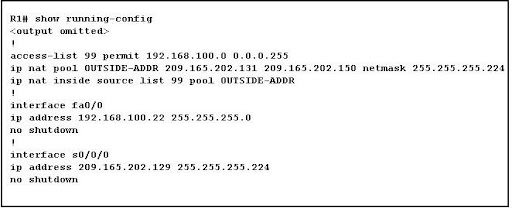
Refer to the exhibit. R1 is connected to the Internet through its serial 0/0/0 interface. Hosts on the 192.168.100.0/24 LAN on R1 cannot communicate with hosts on the Internet. What two NAT configuration issues might explain this failure? (Choose two.)
• The ip nat pool command has not been applied correctly.
• The inside interface has not been defined on R1.
• The access list does not include the group of IP addresses that are supported by the inside network.
• The ip address that is assigned to the serial 0/0/0 interface is incorrect
• The outside interface has not been defined on R1.

22.
5
Refer to the exhibit. R1 and R2 are connected via serial interfaces. Both interfaces show that there is Layer 2 connectivity between them. The administrator verifies that CDP is operational; however, pings between the two interfaces are unsuccessful. What is the cause of this connectivity problem?
• no set loopback
• incorrect subnet mask on R2
• incompatible bandwidth
• incorrect IP address on R1
• incompatible encapsulation

23. Which two statements describe how the information contained in a BPDU is used by a switch? (Choose two.)
• to set the duplex mode of a redundant link
• to activate looped paths throughout the network
• to determine the root bridge
• to prevent loops by sharing routing tables between connected switches
• to determine which ports are placed in forwarding mode

24. When MD5 authentication is used for OSPF routing protocol authentication, what two facts are known about the key? (Choose two.)
• The key passes between routers in plain text.
• The key is used to help generate an encrypted number for authentication.
• The key passes between routers in encrypted form.
• The key is never transmitted.
• The key can be captured by using a packet sniffer.

25.
9
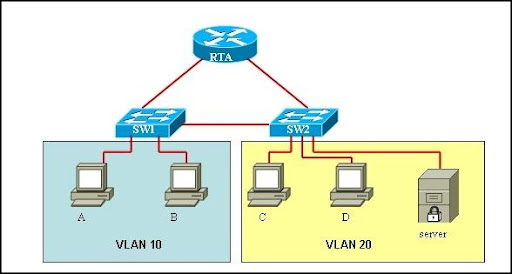
Refer to the exhibit. If router RTA fails, which statement is true?
• Hosts A and B can reach each other, but cannot reach hosts C and D or the server.
• No host can reach any other host.
• Hosts A, B, C, and D can reach each other, but cannot reach the server.
• All hosts can reach each other.

Rabu, 22 Juli 2009

CCNA Discovery 3 - FINAL Exam Answers V.4 #16-20

16. What two statements are true regarding EIGRP tables? (Choose two.)
• A feasible successor route can be found in the topology table.
• A successor route can only be found in the routing table.
• The topology table shows whether a route is in the passive or active state.
• The routing table shows the amount of time elapsed since a router adjacency was formed.
• The neighbor table shows all adjacent Cisco devices.
• Administrative distance is shown as a column in the neighbor table.

17.
10
Refer to the exhibit. Assuming that all three routers are configured with the EIGRP routing protocol and sharing information, what information can be gathered from the show command output?
• Router B has EIGRP adjacencies with both router A and C.
• Router B has a fully converged topology table.
• Router B has not formed an adjacency with router A.
• Router B has not formed an adjacency with router C.

18. Which three statements are true about RSTP? (Choose three.)
• RSTP can fall back to STP to provide support for legacy equipment.
• RSTP and STP have the same number of port states.
• Like PortFast and UplinkFast, RSTP is a proprietary protocol.
• RSTP takes up to 50 seconds to converge.
• RSTP requires a point-to-point, full-duplex connection.
• RSTP views all ports that are not discarding as part of an active topology.

19.
15
Refer to the exhibit. A network support technician has been asked to set an IP address on one of the FastEthernet interfaces on a new router. What is causing the interface to reject the address?
• The IP address is already in use.
• The technician is using a network address.
• The technician is using the wrong subnet mask for /26
• The technician must enable VLSM on the interface.

20.
8
Refer to the exhibit. A network administrator enters the command ip route 10.10.4.16 255.255.255.248 s0/0/1 into the router. What will be the result of this configuration?
• A static route pointing to 10.10.4.16/29 is placed into the routing table.
• A static route to 10.10.4.16/29 is placed into the routing table if interface FastEthernet0/1 goes down.
• A static route pointing to 10.10.4.16/29 is only placed into the routing table if the route to 10.10.4.0 is removed.
• A static route is not placed into the routing table because a RIP route that includes the destination network already exists.

Senin, 29 Juni 2009

CCNA Discovery 3 - FINAL Exam Answers V.4 #11-15

11.
4
What is the term for the value 2172416 that is highlighted in the output of the show ip eigrp topology command?
• feasible distance of the successor
• reported distance of the successor
• feasible distance of the feasible successor
• reported distance of the feasible successor

12.
16
Refer to the exhibit. RIPv2 is configured in the network shown. Hosts in the network have access to all internal networks but do not have Internet access. On which router should the commands, shown in the exhibit, be added to provide Internet access for all hosts in the network?
• R1
• R2
• R3
• ISP

13. What do companies gain from the services performed at the enterprise edge?
• faster communication with server farms
• stronger security against malicious attacks
• faster communication with Internet destinations
• enhanced performance and reliability through VLANs and redundant trunk links

14.
11
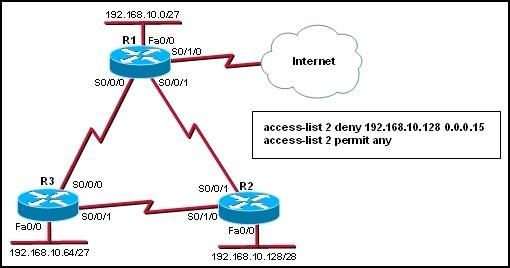
Refer to the exhibit. A network administrator wishes to deny Internet access to all R2 LAN hosts, while allowing these hosts to reach all other devices on the company networks. Where the ACL shown in the exhibit should be placed to meet these requirements?
• R2: Fa0/0 inbound
• R1: S0/1/0 outbound
• R1: S0/0/1 inbound
• R2: S0/0/1 outbound
• R2: Fa0/0 outbound

15.
6
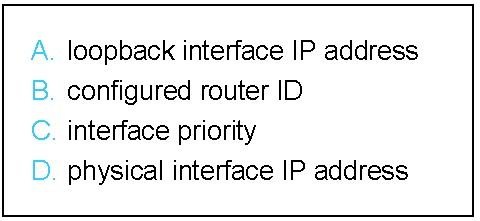
Refer to the exhibit. In what sequence (from first to last) does an OSPF router check the parameters listed when selecting the DR?
• C, B, A, D
• D, C, B, A
• A, B, C, D
• A, C, B, D
• B, C, A, D

Minggu, 31 Mei 2009

CCNA Exploration 1 - Module 9 Exam Answers Version 4.0

1.


In the graphic, Host A has reached 50% completion in sending a 1 KB Ethernet frame to Host D when Host B wishes to transmit its own frame to Host C. What must Host B do?
• Host B can transmit immediately since it is connected on its own cable segment.
• Host B must wait to receive a CSMA transmission from the hub, to signal its turn.
• Host B must send a request signal to Host A by transmitting an interframe gap.
Host B must wait until it is certain that Host A has completed sending its frame.
2. Ethernet operates at which layers of the OSI model? (Choose two.)
• Network layer
• Transport layer
Physical layer
• Application layer
• Session layer
Data-link layer
3. Which of the following describe interframe spacing? (Choose two.)
the minimum interval, measured in bit-times, that any station must wait before sending another frame.
• the maximum interval, measured in bit-times, that any station must wait before sending another frame.
• the 96-bit payload padding inserted into a frame to achieve a legal frame size
• the 96-bit frame padding transmitted between frames to achieve proper synchronization
the time allowed for slow stations to process a frame and prepare for the next frame.
• the maximum interval within which a station must send another frame to avoid being considered unreachable
4. What three primary functions does data link layer encapsulation provide? (Choose three.)
addressing
error detection
frame delimiting
• port identification
• path determination
• IP address resolution
5. When a collision occurs in a network using CSMA/CD, how do hosts with data to transmit respond after the backoff period has expired?
The hosts return to a listen-before-transmit mode.
• The hosts creating the collision have priority to send data.
• The hosts creating the collision retransmit the last 16 frames.
• The hosts extend their delay period to allow for rapid transmission.
6. What are three functions of the upper data link sublayer in the OSI model? (Choose three.)
• recognizes streams of bits
identifies the network layer protocol.
makes the connection with the upper layers.
• identifies the source and destination applications
insulates network layer protocols from changes in physical equipment.
• determines the source of a transmission when multiple devices are transmitting
7. What does the IEEE 802.2 standard represent in Ethernet technologies?
• MAC sublayer
• Physical layer
Logical Link Control sublayer
• Network layer
8. Why do hosts on an Ethernet segment that experience a collision use a random delay before attempting to transmit a frame?
• A random delay is used to ensure a collision-free link.
• A random delay value for each device is assigned by the manufacturer.
• A standard delay value could not be agreed upon among networking device vendors.
A random delay helps prevent the stations from experiencing another collision during the transmission.

9. Refer to the exhibit. Which option correctly matches the frame field type with the contents that frame field includes?
• header field - preamble and stop frame
data field - network layer packet
• data field - physical addressing
• trailer field - FCS and SoF
10. Host A has an IP address of 172.16.225.93 and a mask of 255.255.248.0. Host A needs to
communicate with a new host whose IP is 172.16.231.78. Host A performs the ANDing operation on the destination address. What two things will occur? (Choose two.)
• Host A will change the destination IP to the IP of the nearest router and forward the packet.
• Host A will broadcast an ARP request for the MAC of its default gateway.
• A result of 172.16.225.0 will be obtained.
Host A will broadcast an ARP request for the MAC of the destination host.
• A result of 172.16.224.0 will be obtained.
A result of 172.16.225.255 will be obtained.
11 Which of the following is a drawback of the CSMA/CD access method?
Collisions can decrease network performance.
• It is more complex than non-deterministic protocols.
• Deterministic media access protocols slow network performance.
• CSMA/CD LAN technologies are only available at slower speeds than other LAN technologies.
12. Ethernet operates at which layer of the TCP/IP network model?
• application
• physical
• transport
• internet
• data link
network access
13. What is the primary purpose of ARP?
• translate URLs to IP addresses
resolve IPv4 addresses to MAC addresses
• provide dynamic IP configuration to network devices
• convert internal private addresses to external public addresses.
14.


Refer to the exhibit. The switch and workstation are administratively configured for full-duplex
operation. Which statement accurately reflects the operation of this link?
No collisions will occur on this link.
• Only one of the devices can transmit at a time.
• The switch will have priority for transmitting data.
• The devices will default back to half duplex if excessive collisions occur.
15.


Refer to the exhibit. Host_A is attempting to contact Server_B. Which statements correctly describe the addressing Host_A will generate in the process? (Choose two.)
• A packet with the destination IP of Router_B.
• A frame with the destination MAC address of Switch_A.
• A packet with the destination IP of Router_A.
A frame with the destination MAC address of Router_A.
A packet with the destination IP of Server_B.
• A frame with the destination MAC address of Server_B.
16 Which statements correctly describe MAC addresses? (Choose three.)
• dynamically assigned
copied into RAM during system startup
• layer 3 address
contains a 3 byte OUI
6 bytes long
• 32 bits long
17. Which two features make switches preferable to hubs in Ethernet-based networks? (Choose two.)
• reduction in cross-talk
minimizing of collisions
• support for UTP cabling
• division into broadcast domains
increase in the throughput of communications
18. What are the two most commonly used media types in Ethernet networks today? (Choose two.)
coaxial thicknet copper UTP
• coaxial thinnet
• optical fiber
• shielded twisted pair

19. Convert the binary number 10111010 into its hexadecimal equivalent. Select the correct answer from the list below.
• 85
• 90
BA
• A1
• B3
• 1C
20. After an Ethernet collision, when the backoff algorithm is invoked, which device has priority to transmit data?
• the device involved in the collision with the lowest MAC address
• the device involved in the collision with the lowest IP address
any device in the collision domain whose backoff timer expires first
• those that began transmitting at the same time