Jumat, 03 Juli 2009

Linux home networking - syslog Configuration and Cisco Devices

Cisco Routers

By default Cisco routers send syslog messages to their logging server with a default facility of local7. Don't set the facility in this case, but do tell the router to timestamp the messages and make the messages have the source IP address of the loopback interface.

service timestamps log datetime localtime
no logging console
no logging monitor
logging 192.168.1.100

Catalyst CAT Switches running CATOS

By default Cisco switches also send syslog messages to their logging server with a default facility of local7. Don't change this facility either, therefore making routers and switches log to the same file.

set logging server enable
set logging server 192.168.1.100
set logging level all 5
set logging server severity 6

Cisco Local Director

Local Directors use the syslog output command to set their logging facility and severity. The value provided must be in the format FF.SS (facility.severity) using the numbering scheme in Table IV-1:

Table IV-1 Syslog Facility and Severity Numbering Scheme for Local Directors

Facility

FF Value

Severity

SS Value

local 0

16

System unusable

0

local 1

17

Immediate action required

1

local 2

18

Critical condition

2

local 3

19

Error conditions

3

local 4

20

Warning conditions

4

local 5

21

Normal but significant conditions

5

local 6

22

Informational messages

6

local 7

23

Debugging messages

7

This example uses facility local4 and the logging debugging messages from Table IV-1.

syslog output 20.7
no syslog console
syslog host 192.168.1.100

Cisco PIX Filewalls

PIX firewalls use the numbering scheme in Table IV.2 to determine their logging facilities.

Table IV-2 Syslog Facility and Severity Numbering Scheme for PIX Firewalls

Facility

Logging Facility

Command Value

local 0

16

local 1

17

local 2

18

local 3

19

local 4

20

local 5

21

local 6

22

local 7

23

This configuration example assumes that the logging server is connected on the side of the "inside" protected interface. It sends log messages to facility local3 with a severity level of 5 (Notification) set by the logging trap command.


logging on
logging standby
logging timestamp
logging trap notifications
logging facility 19
logging host inside 192.168.1.100

Cisco CSS11000 (Arrowpoints)

The configuration for the Cisco CSS11000 load balancer series is more straightforward. You specify the facility with an intuitive number using the logging host command and set the severity with the logging subsystem command. This example shows the CSS11000 logging facility local6 and severity level 6 (Informational):

logging host 192.168.1.100 facility 6
set logging subsystem all info-6
logging commands enable

The Sample Cisco syslog.conf File

#
# All LOCAL3 messages (debug and above) go to the firewall file ciscofw
#
local3.debug /var/log/cisco/ciscofw

#
# All LOCAL4 messages (debug and above) go to the Local Director file ciscold
#
local4.debug /var/log/cisco/ciscold

#
# All LOCAL6 messages (debug and above) go to the CSS file ciscocss
#
local6.debug /var/log/cisco/ciscocss

#
# All LOCAL7 messages (debug and above) go to the ciscoacl
# This includes ACL logs which are logged at severity debug
#
local7.debug /var/log/cisco/ciscoacl

#
# LOCAL7 messages (notice and above) go to the ciscoinfo
# This excludes ACL logs which are logged at severity debug
#
local7.notice /var/log/cisco/ciscoinfo

Rabu, 01 Juli 2009

CCNA Discovery 4 - Module 8 Exam Answers V.4 #1-5

1. Which mechanism is used to create a floating static route?
• administrative distance
• cost
• hop count
• passive interface

2. IPSec operates at which layer of the OSI model?
• application
• network
• datalink
• transport

3. Which is true regarding Frame Relay LMI?
• There are three LMI types standardized by ANSI, ITU-T, and Cisco.
• Routers at each end of a Frame Relay virtual circuit must always use the same LMI type.
• The LMI type must be manually configured.
• The only function of LMI is to verify the connection between the router and the Frame Relay switch.

4. Which statement identifies the IP address design for subinterfaces that are configured for a Frame Relay network?
• Multipoint configurations require the IP address of each subinterface on each router to be in its own subnet.
• Multipoint configurations require IP addresses for each subinterface on each router to be a part of the same subnet.
• Point-to-point configurations require IP addresses for each subinterface on each router to be a part of the same subnet.
• Point-to-point configurations do not require IP addresses on each subinterface on each router.
• Multipoint configurations do not require IP addresses on each subinterface on each router.

5. Which three algorithms can be used to encrypt user data in an IPSec VPN framework? (Choose three.)
• 3DES
• AES
• Diffie-Hellman
• DES
• ESP
• SHA

CCNA Discovery 4 - Module 8 Exam Answers V.4 #1-5

1. Which mechanism is used to create a floating static route?
• administrative distance
• cost
• hop count
• passive interface

2. IPSec operates at which layer of the OSI model?
• application
• network
• datalink
• transport

3. Which is true regarding Frame Relay LMI?
• There are three LMI types standardized by ANSI, ITU-T, and Cisco.
• Routers at each end of a Frame Relay virtual circuit must always use the same LMI type.
• The LMI type must be manually configured.
• The only function of LMI is to verify the connection between the router and the Frame Relay switch.

4. Which statement identifies the IP address design for subinterfaces that are configured for a Frame Relay network?
• Multipoint configurations require the IP address of each subinterface on each router to be in its own subnet.
• Multipoint configurations require IP addresses for each subinterface on each router to be a part of the same subnet.
• Point-to-point configurations require IP addresses for each subinterface on each router to be a part of the same subnet.
• Point-to-point configurations do not require IP addresses on each subinterface on each router.
• Multipoint configurations do not require IP addresses on each subinterface on each router.

5. Which three algorithms can be used to encrypt user data in an IPSec VPN framework? (Choose three.)
• 3DES
• AES
• Diffie-Hellman
• DES
• ESP
• SHA

Senin, 29 Juni 2009

CCNA Discovery 3 - FINAL Exam Answers V.4 #11-15

11.
4
What is the term for the value 2172416 that is highlighted in the output of the show ip eigrp topology command?
• feasible distance of the successor
• reported distance of the successor
• feasible distance of the feasible successor
• reported distance of the feasible successor

12.
16
Refer to the exhibit. RIPv2 is configured in the network shown. Hosts in the network have access to all internal networks but do not have Internet access. On which router should the commands, shown in the exhibit, be added to provide Internet access for all hosts in the network?
• R1
• R2
• R3
• ISP

13. What do companies gain from the services performed at the enterprise edge?
• faster communication with server farms
• stronger security against malicious attacks
• faster communication with Internet destinations
• enhanced performance and reliability through VLANs and redundant trunk links

14.
11
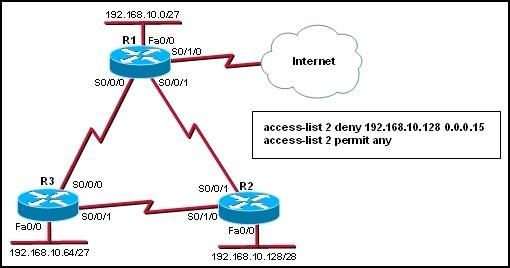
Refer to the exhibit. A network administrator wishes to deny Internet access to all R2 LAN hosts, while allowing these hosts to reach all other devices on the company networks. Where the ACL shown in the exhibit should be placed to meet these requirements?
• R2: Fa0/0 inbound
• R1: S0/1/0 outbound
• R1: S0/0/1 inbound
• R2: S0/0/1 outbound
• R2: Fa0/0 outbound

15.
6
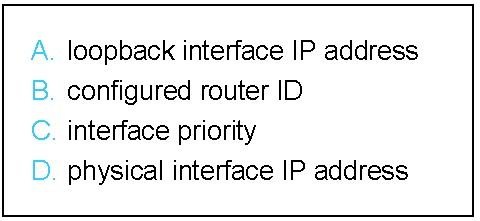
Refer to the exhibit. In what sequence (from first to last) does an OSPF router check the parameters listed when selecting the DR?
• C, B, A, D
• D, C, B, A
• A, B, C, D
• A, C, B, D
• B, C, A, D

Jumat, 26 Juni 2009

Frame Relay - Introduction

Introduction

Frame Relay is a high-performance WAN protocol that operates at the physical and data link layers of the OSI reference model. Frame Relay originally was designed for use across Integrated Services Digital Network (ISDN) interfaces. Today, it is used over a variety of other network interfaces as well. This chapter focuses on Frame Relay's specifications and applications in the context of WAN services.

Frame Relay is an example of a packet-switched technology. Packet-switched networks enable end stations to dynamically share the network medium and the available bandwidth. The following two techniques are used in packet-switching technology:

Variable-length packets

Statistical multiplexing

Variable-length packets are used for more efficient and flexible data transfers. These packets are switched between the various segments in the network until the destination is reached.

Statistical multiplexing techniques control network access in a packet-switched network. The advantage of this technique is that it accommodates more flexibility and more efficient use of bandwidth. Most of today's popular LANs, such as Ethernet and Token Ring, are packet-switched networks.

Frame Relay often is described as a streamlined version of X.25, offering fewer of the robust capabilities, such as windowing and retransmission of last data that are offered in X.25. This is because Frame Relay typically operates over WAN facilities that offer more reliable connection services and a higher degree of reliability than the facilities available during the late 1970s and early 1980s that served as the common platforms for X.25 WANs. As mentioned earlier, Frame Relay is strictly a Layer 2 protocol suite, whereas X.25 provides services at Layer 3 (the network layer) as well. This enables Frame Relay to offer higher performance and greater transmission efficiency than X.25, and makes Frame Relay suitable for current WAN applications, such as LAN interconnection.

Minggu, 21 Juni 2009

FINAL Exam Answers V.4- CCNA Discovery 3 - #6-10

6. A sales representative is preparing to send sensitive information to corporate headquarters from a hotel room using the Internet. Prior to the trip, the IT staff made the necessary provisions to allow secure Internet access. What solution was implemented for the sales representative?
• VPN
• Frame Relay
• PPP with CHAP authentication
• PPP with PAP authentication

7.
1
Refer to the exhibit. A network administrator noticed that the VLAN configuration changes at SW2 did not propagate to SW3. On the basis of the partial output of the show vtp status command, what is the possible cause of the problem?
• VTP V2 mode is disabled.
• SW3 is configured as transparent mode.
• The number of existing VLANs does not match.
• The configuration revision number does not match.

8.
1
Refer to the exhibit. Because of continuing instability of one of the serial links in the OSPF network, a network administrator configures router ASBR as shown. Which two statements will be a result of this configuration? (Choose two.)
• Traffic intended for destinations across unstable serial links will be forwarded by ASBR even when the links are down
• A summary route of 192.168.0.0/22 will be advertised to the ISP router.
• Serial links in range 192.168.0.0 255.255.252.0 will be forced into a passive state.
• Networks connected to the unstable serial links will be placed in an unreachable state.
• Negative effects of route flapping will be reduced.

9. Which two criteria are used by STP to select a root bridge? (Choose two.)
• memory size
• bridge priority
• number of ports
• switch location
• switching speed
• base MAC address

10. A company is using a Class B IP addressing scheme and expects to need as many as 150 networks. What is the correct subnet mask to use with the network configuration?
• 255.255.0.0
• 255.255.240.0
• 255.255.254.0
• 255.255.255.0
• 255.255.255.128
• 255.255.255.192

Kamis, 18 Juni 2009

CCNA Discovery 3 - FINAL Exam Answers V.4 #1-5

1. In which VTP mode can a switch create VLANs, ignore VTP messages, and not pass local VLAN information to other VTP domain members?
• client
• server
• pruning
• transparent

2. What are two characteristics of an extended ACL? (Choose two.)
• IP is used to specify TCP traffic only.
• IP is used to specify TCP and UDP traffic only.
• IP is used to specify all TCP/IP protocols including TCP, UDP, ICMP and routing protocols.
• Traffic can be filtered on source address only.
• Traffic can be filtered on source and destination address only.
• Traffic can be filtered on source and destination address, protocol, and specific port number.

3. Which two statements are true regarding a PPP connection between two Cisco routers? (Choose two.)
• LCP tests the quality of the link.
• LCP manages compression on the link

• Only a single NCP is allowed between the two routers.
• NCP terminates the link when data exchange is complete.
• With CHAP authentication, the routers exchange plain text passwords.

4. Assuming VLSM is not being used, what impact will adding the command ip route 172.16.64.0 255.255.240.0 serial0/0 have on a router that is already operational in a network?
• All packets with a destination address between 172.16.64.1 and 172.16.80.254 will be forwarded out serial0/0.
• All packets with a destination address between 172.16.64.1 and 172.16.255.254 will be forwarded out serial0/0.
• All packets with a destination address between 172.16.64.1 and 172.16.79.254 will be forwarded out serial0/0.
• All packets with a destination address between 172.16.0.1 and 172.16.64.254 will be forwarded out serial0/0.

5.
8
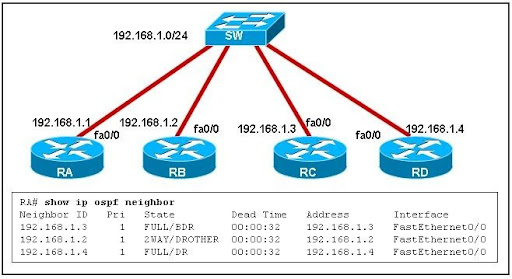
Refer to the exhibit. The network is using OSPF as the routing protocol. A network administrator issues the show ip ospf neighbor command to check the status of operation. Which statement is true?
• RB has the lowest priority value.
• RC and RD have the lowest router IDs on the network.
• RA has established adjacencies with all neighbor routers.
• RA and RB cannot form an adjacency because they are stuck in the 2-way state.