11
Refer to the exhibit. Hosts A and B, connected to hub HB1, attempt to transmit a frame at the same time but a collision occurs. Which
hosts will receive the collision jamming signal?
only hosts A and B
only hosts A, B, and C
only hosts A, B, C, and D
only hosts A, B, C, and E
12
What are three benefits of employing a hierarchical network design? (Choose three.)
Hierarchically designed networks can more easily be expanded to suit future needs.
Hierarchical design models enhance existing bandwidth through the use of link aggregation.
The hierarchical model allows for specialized functionality at each layer, simplifying device management.Use of a hierarchical design allows replacement of redundant devices with high-capacity network equipment.
A hierarchical design uses firewalls instead of complicated port-based and distribution layer security policies.
The hierarchical model allows the use of high-performance switches at all design layers, thus allowing for a fully-meshed topology.
13
A network administrator implements inter-VLAN routing by configuring subinterfaces on a router. What is one important fact that must considered?
The physical interface must have an IP address configured.
The subinterface numbers must match the VLAN ID number.
The no shutdown command must be issued on each subinterface.
The IP address of each router subinterface must be used as the default gateway for hosts on the corresponding VLAN.
14
Which type of frame contains information that is used in the election of the spanning tree root bridge?
BID
LSA
LSU
BPDU
15
Refer to the exhibit. Each switch is shown with its MAC address. Which switch will be elected as the spanning-tree root bridge if the
switches are configured with their default priority values?
switch A
switch B
switch C
switch D
switch E
switch F
Close Window
Assessment System
1. Assessment Selection 2. Assessment Settings 3. Take Assessment
Take Assessment - ESwitching Final Exam - CCNA Exploration: LAN Switching and
Wireless (Version 4.0)
Time Remaining:
16
Refer to the exhibit. What will happen when frames with a source address other than 0019.d2e4.d9f7 enters interface Fa0/24?
Fa0/24 will become error-disabled.
The incoming frames will be dropped.
The Fa0/24 port LED will be turned off.
The security violation count will be incremented.
17
Refer to the exhibit. The network administrator has just added VLAN 50 to Switch1 and Switch2. Hosts A, B, C, and D are correctly
configured with IP addresses in the subnet range for VLAN 50. Host A can communicate with host B, but cannot communicate with C or host D. What is the cause of this problem?
There is a native VLAN mismatch.
The Fa0/11 interface of Switch1 is not configured as a trunk.
The link between Switch1 and Switch2 is up but not trunked.
VLAN 50 is not allowed on the trunk link between Switch1 and Switch2.
18
Refer to the exhibit. A network administrator enters the displayed commands to configure VLAN 30. What is the result of running these
commands?
VLAN 30 will be added to S1, S2, and S3, but not to S4.
VLAN 30 will be pruned from the VLAN database of S3.
VLAN 30 will be added to the VLAN database of S3 but will not be propagated to S4, S2 or S1.
VLAN 30 will not be added to the VLAN database of S3 and an error message will be displayed.
19
Refer to the exhibit. R1 is configured for traditional inter-VLAN routing. R1 can ping computer 3 but cannot ping computer 1. What is possible cause for this failure?
S1 port Fa0/11 is in the wrong VLAN.
R1 does not have an active routing protocol.
The IP address of computer 1 is in the wrong logical network.
Router interface Fa0/0 has the wrong trunk encapsulation type configured.
20
Refer to the exhibit. How does SW1 manage traffic coming from Host A?
SW1 drops the traffic because it is untagged.
SW1 leaves the traffic untagged and forwards it over the trunk.
SW1 tags the traffic with the lowest VLAN ID value and forwards it over the trunk link.
SW1 encapsulates the traffic with 802.1Q encapsulation and forwards it over the trunk link.
Selasa, 09 Maret 2010


CCNA3 Final - March 2010 #1
1
Which value determines if a switch becomes the central point of reference in the spanning tree topology?
lowest bridge ID
highest revision number
lowest numeric IP address
highest numeric MAC address
2
Refer to the exhibit. What is the purpose of the configuration commands that are shown?
to activate port Fa0/10
to make the port a member of VLAN 30
to activate port security on port Fa0/10
to add VLAN 30 to the trunk that is connected to port Fa0/10
3
Refer to the exhibit. What would happen if the network administrator moved the network cable of Host A from interface Fa0/1 to Fa0/switch SW1?
Host A remains a member of VLAN 10, because the router is routing traffic between VLANs.
Host A is no longer a member of VLAN 10, because port Fa0/3 has been manually assigned to VLAN 30.
Host A remains a member of VLAN 10, because the switch provides dynamic VLAN assignment for the port.
Host A maintains connectivity to all members of VLAN 10, because it is connected to the same physical network.
Host A is no longer a member of VLAN 10, but because port Fa0/3 was unused, it is now a member of VLAN 1.
4
Which device or devices should have the Spanning Tree Protocol enabled to prevent host traffic from creating a broadcast storm?
Core_S1
Access_S2 and Access_S3
Core_S1, Access_S2, and Access_S3
Core_S1, Access_S2, Access_S3, and R1
5
Refer to the exhibit. The hosts connected to switch SW1 are not able to communicate with the hosts in the same VLANs connected switch SW2. What should be done to fix the problem?
Configure VLANs with different VLAN IDs on switch SW2.
Reconfigure the trunk port on switch SW2 with static trunk configuration.
Introduce a Layer 3 device or a switch with Layer 3 capability in the topology.
Apply IP addresses that are in the same subnet to the interfaces used to connect SW1 and SW2.
6
Refer to the exhibit. The Layer 2 switching design that is shown has been implemented in a campus environment that is using Spanning
Tree Protocol. All inter-switch links that are shown are trunks. Whenever an inter-switch link fails, the network takes nearly a minute completely converge. How can the convergence time be reduced?
Increase the capacity of the distribution and core trunk links to 10 Gb/s.
Add a trunk link that directly connects D1 and D2.
Use Layer 3 switching on the core switch.
Implement Rapid Spanning Tree Protocol.
7
What will be the effect of the command S1# copy system:running-config tftp://172.16.2.155/tokyo-config?
The IOS will be copied to the TFTP server.
The configuration file named tokyo-config will overwrite the startup configuration file on S1.
The running configuration file on S1 will be saved via TFTP to a file named tokyo-config.
The contents of NVRAM on S1 will become the startup configuration file on the tokyo switch.
8
Refer to the exhibit. What does the term DYNAMIC indicate in the output that is shown?
This entry can only be removed from the MAC address table by a network administrator.
When forwarding a frame to the device with address 0060.5c5b.cd23, the switch does not have to perform a lookup to determine
the final destination port.
Only the device with MAC address 0060.5c5b.cd23 will be allowed to connect to port Fa0/18.
The switch learned this MAC address from the source address in a frame received on Fa0/18.
9
Which two statements are correct about wireless infrastructure components? (Choose two.)
An AP converts the TCP/IP data packets from their 802.11 frame encapsulation format to the 802.3 Ethernet frame format on the
wired Ethernet network.
A wireless AP does not require any physical connection to allow wireless clients to access the Internet.
An AP is a layer 2 device, similar to a switch, that provides dedicated bandwidth to each connected wireless host.
Collisions do not occur between wireless NICs and APs.
The wireless router performs the roles of AP and router.
10
Which service should be disabled on a Cisco switch or router to prevent packet sniffers from capturing information about the device?
SSH
VTP
CDP
SNMP
Which value determines if a switch becomes the central point of reference in the spanning tree topology?
lowest bridge ID
highest revision number
lowest numeric IP address
highest numeric MAC address
2
Refer to the exhibit. What is the purpose of the configuration commands that are shown?
to activate port Fa0/10
to make the port a member of VLAN 30
to activate port security on port Fa0/10
to add VLAN 30 to the trunk that is connected to port Fa0/10
3
Refer to the exhibit. What would happen if the network administrator moved the network cable of Host A from interface Fa0/1 to Fa0/switch SW1?
Host A remains a member of VLAN 10, because the router is routing traffic between VLANs.
Host A is no longer a member of VLAN 10, because port Fa0/3 has been manually assigned to VLAN 30.
Host A remains a member of VLAN 10, because the switch provides dynamic VLAN assignment for the port.
Host A maintains connectivity to all members of VLAN 10, because it is connected to the same physical network.
Host A is no longer a member of VLAN 10, but because port Fa0/3 was unused, it is now a member of VLAN 1.
4
Which device or devices should have the Spanning Tree Protocol enabled to prevent host traffic from creating a broadcast storm?
Core_S1
Access_S2 and Access_S3
Core_S1, Access_S2, and Access_S3
Core_S1, Access_S2, Access_S3, and R1
5
Refer to the exhibit. The hosts connected to switch SW1 are not able to communicate with the hosts in the same VLANs connected switch SW2. What should be done to fix the problem?
Configure VLANs with different VLAN IDs on switch SW2.
Reconfigure the trunk port on switch SW2 with static trunk configuration.
Introduce a Layer 3 device or a switch with Layer 3 capability in the topology.
Apply IP addresses that are in the same subnet to the interfaces used to connect SW1 and SW2.
6
Refer to the exhibit. The Layer 2 switching design that is shown has been implemented in a campus environment that is using Spanning
Tree Protocol. All inter-switch links that are shown are trunks. Whenever an inter-switch link fails, the network takes nearly a minute completely converge. How can the convergence time be reduced?
Increase the capacity of the distribution and core trunk links to 10 Gb/s.
Add a trunk link that directly connects D1 and D2.
Use Layer 3 switching on the core switch.
Implement Rapid Spanning Tree Protocol.
7
What will be the effect of the command S1# copy system:running-config tftp://172.16.2.155/tokyo-config?
The IOS will be copied to the TFTP server.
The configuration file named tokyo-config will overwrite the startup configuration file on S1.
The running configuration file on S1 will be saved via TFTP to a file named tokyo-config.
The contents of NVRAM on S1 will become the startup configuration file on the tokyo switch.
8
Refer to the exhibit. What does the term DYNAMIC indicate in the output that is shown?
This entry can only be removed from the MAC address table by a network administrator.
When forwarding a frame to the device with address 0060.5c5b.cd23, the switch does not have to perform a lookup to determine
the final destination port.
Only the device with MAC address 0060.5c5b.cd23 will be allowed to connect to port Fa0/18.
The switch learned this MAC address from the source address in a frame received on Fa0/18.
9
Which two statements are correct about wireless infrastructure components? (Choose two.)
An AP converts the TCP/IP data packets from their 802.11 frame encapsulation format to the 802.3 Ethernet frame format on the
wired Ethernet network.
A wireless AP does not require any physical connection to allow wireless clients to access the Internet.
An AP is a layer 2 device, similar to a switch, that provides dedicated bandwidth to each connected wireless host.
Collisions do not occur between wireless NICs and APs.
The wireless router performs the roles of AP and router.
10
Which service should be disabled on a Cisco switch or router to prevent packet sniffers from capturing information about the device?
SSH
VTP
CDP
SNMP
Selasa, 15 Desember 2009
CCNA 3.1 Semester 1 Final Exam Result #1-5
1 Which devices segment collision domains? (Choose two.)
transceiver
* router
* switch
hub
media
This item references content from the following areas:
CCNA 1 Networking Basics
• 8.2.3 Segmentation
2.
Refer to the exhibit. How many collision domains are present in the topology?
3
5
6
* 7
8
9
This item references content from the following areas:
CCNA 1 Networking Basics
• 8.2.2 Collision domains
3.
Refer to the exhibit. An instructor in the network class has given the students the network diagram and asks the students to select the appropriate network devices. The goals are to provide a collision-free LAN environment and to provide Internet connectivity. What is the correct design?
Replace Box 1 with a hub and Box 2 with a router.
Replace Box 1 with a router and Box 2 with a bridge.
* Replace Box 1 with a Layer 2 switch and Box 2 with a router.
Replace Box 1 with a router and Box 2 with a Layer 2 switch.
Replace Box 1 with a bridge and Box 2 with a Layer 2 switch.
This item references content from the following areas:
CCNA 1 Networking Basics
• 10.2.2 Routing versus switching
4.
Refer to the exhibit. A network administrator attempts to increase the available bandwidth for workstation A by setting the NIC to full-duplex mode. After the configuration is changed, there are increased collisions and errors occurring. Why is this occurring in the network?
* The NIC is no longer detecting collisions.
The switch will not support full-duplex mode.
The hub will be continually producing a jam signal.
The cabling will not support bidirectional transmissions.
This item references content from the following areas:
CCNA 1 Networking Basics
• 6.2.10 Link establishment and full and half duplex
5.
Refer to the exhibit. A network administrator is testing a connectivity issue in the network. The administrator discovers that host A cannot communicate with host B, host C, or RouterA. A ping command on host A to 127.0.0.1 succeeds. The NIC link indicator on host A is illuminated. Temporarily, the administrator removes the cable from host A and uses the LAN cable from host B to connect from host A to port 1 on the switch. While using the substitute cable, host A can communicate with host C and RouterA. At which layer of the OSI model was the problem occurring?
session
transport
network
data link
* physical
This item references content from the following areas:
CCNA 1 Networking Basics
• 2.3.4 OSI layers
transceiver
* router
* switch
hub
media
This item references content from the following areas:
CCNA 1 Networking Basics
• 8.2.3 Segmentation
2.

Refer to the exhibit. How many collision domains are present in the topology?
3
5
6
* 7
8
9
This item references content from the following areas:
CCNA 1 Networking Basics
• 8.2.2 Collision domains
3.

Refer to the exhibit. An instructor in the network class has given the students the network diagram and asks the students to select the appropriate network devices. The goals are to provide a collision-free LAN environment and to provide Internet connectivity. What is the correct design?
Replace Box 1 with a hub and Box 2 with a router.
Replace Box 1 with a router and Box 2 with a bridge.
* Replace Box 1 with a Layer 2 switch and Box 2 with a router.
Replace Box 1 with a router and Box 2 with a Layer 2 switch.
Replace Box 1 with a bridge and Box 2 with a Layer 2 switch.
This item references content from the following areas:
CCNA 1 Networking Basics
• 10.2.2 Routing versus switching
4.

Refer to the exhibit. A network administrator attempts to increase the available bandwidth for workstation A by setting the NIC to full-duplex mode. After the configuration is changed, there are increased collisions and errors occurring. Why is this occurring in the network?
* The NIC is no longer detecting collisions.
The switch will not support full-duplex mode.
The hub will be continually producing a jam signal.
The cabling will not support bidirectional transmissions.
This item references content from the following areas:
CCNA 1 Networking Basics
• 6.2.10 Link establishment and full and half duplex
5.

Refer to the exhibit. A network administrator is testing a connectivity issue in the network. The administrator discovers that host A cannot communicate with host B, host C, or RouterA. A ping command on host A to 127.0.0.1 succeeds. The NIC link indicator on host A is illuminated. Temporarily, the administrator removes the cable from host A and uses the LAN cable from host B to connect from host A to port 1 on the switch. While using the substitute cable, host A can communicate with host C and RouterA. At which layer of the OSI model was the problem occurring?
session
transport
network
data link
* physical
This item references content from the following areas:
CCNA 1 Networking Basics
• 2.3.4 OSI layers
Rabu, 25 November 2009
CCNA3 - Final Exam Answers (v.2)
Version 2
1
Refer to the exhibit. The network administrator needs to setup Switch1 for remote access from HostA. The show ip interface brief is issued on Router1 and the show interfaces trunk command is issued on the Switch1 to verify the current status. The administrator applies the additional configuration shown in the exhibit to Switch1. However, the telnet from HostA fails. What additional commands need to be applied to the switch?
Switch(config)# interface vlan 1
Switch(config-if)# ip address 10.1.1.250 255.255.255.0
Switch(config-if)# no shutdown
Switch(config-if)# ip default-gateway 10.1.10.254
Switch(config)# interface vlan 1
Switch(config-if)# ip address 10.1.50.250 255.255.255.0
Switch(config-if)# no shutdown
Switch(config-if)# ip default-gateway 10.1.50.254
Switch(config)# interface vlan 10
Switch(config-if)# ip address 10.1.10.250 255.255.255.0
Switch(config-if)# no shutdown
Switch(config-if)# ip default-gateway 10.1.10.254
Switch(config)# interface vlan 10
Switch(config-if)# ip address 10.1.1.250 255.255.255.0
Switch(config-if)# no shutdown
Switch(config-if)# ip default-gateway 10.1.10.254
Switch(config)# interface vlan 50
Switch(config-if)# ip address 10.1.10.250 255.255.255.0
Switch(config-if)# no shutdown
Switch(config-if)# ip default-gateway 10.1.10.254
2
Refer to the exhibit. On the basis of the configuration shown, how will an Ethernet frame on port
GigabitEthernet0/1 be modified?
802.1Q encapsulation prepends a 4-byte tag field in front of the original Ethernet frame and recomputes frame check sequence (FCS) on the modified frame.
**802.1Q encapsulation inserts a 4-byte tag field into the original Ethernet frame between the source address
and type/length fields and recomputes the frame check sequence (FCS) on the modified frame.
802.1Q encapsulation prepends an 802.1p field in front of the original Ethernet frame and recomputes frame check sequence (FCS) on the modified frame.
802.1Q encapsulation inserts an 802.1p field into the original Ethernet frame between the source address
and type/length fields and recomputes the frame check sequence (FCS) on the modified frame.
3
What VLANs are allowed across a trunk when the range of allowed VLANs is set to the default value?
**All VLANs will be allowed across the trunk.
Only VLAN 1 will be allowed across the trunk.
Only the native VLAN will be allowed across the trunk.
The switches will negotiate via VTP which VLANs to allow across the trunk.
4
Which parameter is used to uniquely identify one wireless network from another?
**SSID
OFDM
WEP
DSSS
5
Refer to the exhibit. What is the consequence if SW1 port F0/1 is configured as an edge port?
SW1 port F0/1 transitions to the learning state.
**SW1 port F0/1 can generate a temporary loop.
SW1 port F0/1 becomes a non-designated port.
SW1 port F0/2 no longer passes BPDUs to SW4.
6
Refer to the exhibit. What will allow a host on VLAN 40 on switch X to communicate with a host in VLAN on switch Y?
QoS
routing
**trunking
VPN
7
Refer to the exhibit. Spanning-tree port priorities are 128 for all interfaces. The network administrator enters spanning-tree vlan 1 root primary command on S4. Which two port results are correct? (Choose two.)
**S1 Gi0/1 becomes a root port.
S2 Gi0/2 becomes a non-designated port.
S3 Gi0/1 becomes a non-designated port.
S4 Gi0/1 becomes a root port.
**S4 Gi0/2 becomes a designated port.
8
Refer to the exhibit. Which two facts can be confirmed by this output? (Choose two.)
This switch shows no configuration revision errors.
This switch has established two-way communication with the neighboring devices.
**This switch is configured to advertise its VLAN configuration to other VTP-enabled switches in the VTP domain.
This switch will drop all VTP advertisements that come from the switches that are configured in the VTP domain.
**This switch will cause no disruption in the VTP domain operations if the rest of the switches in the same
VTP domain have a higher configuration revision number.
9
Refer to the exhibit. R1 is configured for traditional inter-VLAN routing. R1 can ping computer 3 but cannot
ping computer 1. What is a possible cause for this failure?
**S1 port Fa0/11 is in the wrong VLAN.
R1 does not have an active routing protocol.
The IP address of computer 1 is in the wrong logical network.
Router interface Fa0/0 has the wrong trunk encapsulation type configured.
10
Refer to the exhibit. Both switches are interconnected via a trunk link. Host A and host B are on the default
VLAN but are not able to exchange traffic. What should be done to fix the problem?
Allow all VLANs on the trunk link.
Remove the native VLAN from the trunk.
Include a router or switch with Layer 3 capabilities.
**Configure the same native VLAN on both ends of the trunk.
11
Refer to the exhibit. The hosts connected to switch SW1 are not able to communicate with the hosts in the
same VLANs connected to switch SW2. What should be done to fix the problem?
Configure VLANs with different VLAN IDs on switch SW2.
**Reconfigure the trunk port on switch SW2 with static trunk configuration.
Introduce a Layer 3 device or a switch with Layer 3 capability in the topology.
Apply IP addresses that are in the same subnet to the interfaces used to connect SW1 and SW2.
12
What happens when the crypto key zeroize rsa command is entered on a switch configured with the
transport input ssh command on the vty lines?
A new RSA key pair is created.
The switch defaults to allowing Telnet connections only.
The switch is no longer able to make SSH connections as an SSH client.
**The switch allows remote connections only after a new RSA key pair is generated.
13
Refer to the exhibit. An Ethernet switch has developed the CAM table shown. What action will the switch when it receives the frame shown at the bottom of the exhibit?
**forward the frame out all interfaces except Interface3
add station 00-00-3D-1F-11-05 to Interface2 in the forwarding table
forward the frame out Interface3
discard the frame
forward the frame out all interfaces
forward the frame out Interface2
14
Which two statements describe Spanning Tree Protocol? (Choose two.)
**It eliminates Layer 2 loops in network topologies.
It eliminates the need for redundant physical paths in network topologies.
**It can only be used in networks in which Layer 2 switching is in use.
It can only be used in networks where both routers and switches are used together.
It can only be used in networks where routers are installed.
15
Refer to the exhibit. A new host needs to be connected to VLAN 1. Which IP addresses should be assigned this new host?
192.168.1.11 /28
**192.168.1.22 /28
192.168.1.33 /28
192.168.1.44 /28
192.168.1.55 /28
16
Refer to the exhibit. How does SW1 manage traffic coming from Host A?
SW1 drops the traffic because it is untagged.
**SW1 leaves the traffic untagged and forwards it over the trunk.
SW1 tags the traffic with the lowest VLAN ID value and forwards it over the trunk link.
SW1 encapsulates the traffic with 802.1Q encapsulation and forwards it over the trunk link.
17
Refer to the exhibit. The switches are configured for VTP as shown. Which two statements correctly describe
the operation of these switches? (Choose two.)
A new VLAN can be added to Switch1 and that information will be added only to Switch2.
**A new VLAN can be added to Switch1 and that information will be added to Switch2 and Switch4.
**An existing VLAN can be deleted from Switch4 and that VLAN will be deleted from Switch1 and
Switch2.
An existing VLAN can be deleted from Switch2 and that VLAN will be deleted from Switch1 and
Switch4.
A new VLAN can be added to Switch4 and that information will be added to Switch1, Switch2, and
Switch3.
A new VLAN can be added to Switch3 and that information will be added to Switch1, Switch2, and
Switch4.
18
Refer to the exhibit. Computer A sends a broadcast message. Which devices will see the broadcast?
computer B
computer B and Router1
**computer C and Router1
computer B, computer D, computer E and Router1
computer B, computer C, computer D, computer E and Router1
computer A, computer B, computer C, computer D, computer E and Router1
19
Refer to the exhibit. The network administrator enters the configuration shown to allow both SSH and Telnet
connections to the switch. The Telnet connections fail. What is the most likely cause of this problem?
The SSH version number is wrong.
SSH has been configured on the wrong line.
Telnet and SSH cannot be configured simultaneously.
**The transport input command is configured incorrectly.
20
Refer to the exhibit. Which switch will be elected as the root bridge of the spanning tree topology?
Cat-A
Cat-B
**Cat-C
Cat-D
21
Refer to the exhibit. The switches in the exhibit have VTP pruning enabled. Which VLANs will be pruned
from switch SW3?
**VLAN 10 and VLAN 20
VLAN 1, VLAN 10, and VLAN 20
VLAN 1, VLAN 1002 through 1005
VLAN 1, VLAN 10, VLAN 20, VLAN 1002 through 1005
22
Refer to the exhibit. What does STATIC indicate in the output that is shown?
The switch will not allow any other device to connect to port Fa0/15.
**Traffic destined for MAC address 0000.c123.5432 will be forwarded to Fa0/15.
This entry will be removed and refreshed every 300 seconds to keep it in the table.
The switch learned this MAC address from the source address in a frame received on Fa0/15.
When processing a frame, the switch does not have to perform a lookup to determine the final destination
port.
23
Which three statements are true regarding router-on-a-stick inter-VLAN routing? (Choose three.)
**requires the use of subinterfaces on the router
requires an access link between the router and Layer 2 switch
**more cost-efficient and scalable than using multiple physical interfaces
requires each subinterface to be configured with the no shutdown command
**can impact performance if many VLANs compete for bandwidth on a single router interface
makes troubleshooting the inter-VLAN routing configuration much less complex than when using multiple
physical interfaces
24
Refer to the exhibit. Router RA receives a packet with a source address of 192.168.1.35 and a destination
address of 192.168.1.85. What will the router do with this packet?
The router will forward the packet out interface FastEthernet 0/1.1.
The router will forward the packet out interface FastEthernet 0/1.2.
The router will forward the packet out interface FastEthernet 0/1.3.
The router will forward the packet out interface FastEthernet 0/1.2 and interface FastEthernet 0/1.3
**The router will ignore the packet because the source and destination are on the same broadcast domain
The router will drop the packet since no network that includes the source address is attached to the
25
Refer to the exhibit. The network administrator needs to remove the east-hosts VLAN and use the switch from that VLAN in one of the existing VLANs. What two commands should be used when completely
removing VLAN 2 from S1-Central while leaving the switch and all its interfaces operational? (Choose S1-Central# reload
S1-Central# erase flash:
**S1-Central(config)# no vlan 2
S1-Central# delete flash:vlan.dat
**S1-Central(config-if)# switchport access vlan 3
26
Refer to the exhibit. What does "FORWARDING" mean in the command output shown?
**The switch is sending and receiving data frames.
The switch is receiving BPDUs, but not sending data frames.
The switch is participating in an election process by forwarding the BPDUs it receives.
The switch is receiving BPDUs and populating the MAC address table, but not sending data.
27
Refer to the exhibit. Switch SW2 has been newly purchased and added to the network. What configuration
should be applied to SW2 so that it participates in the same VTP domain as switch SW1, receives VLAN
information from SW1, and synchronizes VLAN information?
Disable VTP pruning on SW2.
Configure SW2 in VTP transparent mode.
**Configure SW2 with the VTP domain password.
Configure SW2 as a VTP server with a higher revision number.
28
What are three benefits of a hierarchical network model? (Choose three.)
**reduced contention for bandwidth
reduced size of the physical layout
**increased fault tolerance of the network
elimination of the need for wiring closets
elimination of the need for layer three functionality
**simplification of management and troubleshooting
29
Refer to the exhibit. Which three options correctly identify information that could be associated with this
output?(Choose three.)
**Interface FastEthernet3/0/0 is subinterfaced.
**A non-proprietary trunking protocol is in use.
**The configuration is appropriate for a router-on-a-stick network design.
A shutdown command has been applied to interface FastEthernet3/0/0.
Interface FastEthernet3/0/0.3 is mapped to the default management VLAN.
An IP address should be applied to FastEthernet3/0/0 for correct data routing.
30
Refer to the exhibit. Switch SW2 was tested in a lab environment and then inserted into a production network
without reloading its configuration. After the trunk link between SW1 and SW2 was brought up, all users connectivity to the network. What could be the source of the problem?
All the VLANs were pruned from the trunk port between SW1 and SW2.
SW1 and SW2 cannot be both set as VTP servers in the same VTP domain.
**VTP configuration revision number of SW2 was higher than the configuration revision number of SW1.
The additional VLANs from SW2 created more VLANs than the VLAN database of SW1 could contain
31
Refer to the exhibit. A network administrator needs to implement inter-VLAN routing on a hierarchical
network. On which devices should the inter-VLAN routing be configured?
AS1 and AS2
DS1 and DS2
**Gateway and CS1
Gateway, CS1, DS1, and DS2
32
Which three statements are correct concerning the default configuration of a new switch? (Choose three.
Spanning Tree Protocol is disabled.
Enable password is configured as cisco.
**All switch ports are assigned to VLAN1.
**The flash directory contains the IOS image.
VLAN1 is configured with a management IP address.
**All interfaces are set to auto-negotiation of speed and duplex.
33
Refer to the exhibit. All hosts are in listen mode. Host 1 and Host 4 both transmit data at the same time. do the hosts respond on the network? (Choose two.)
**After the end of the jam signal, a backoff algorithm is invoked.
Hosts 1 and 4 are operating full duplex so no collision will exist.
The hub will block the port connected to Host 4 to prevent a collision.
Hosts 1 and 4 are assigned shorter backoff values to provide them priority to access the media.
**If a host has data to transmit after the backoff period of that host, the host checks to determine if the idle before transmitting.
34
Refer to the exhibit. After the listed commands are entered into router R1 and switch S1, the administrator
enters the show interface fa0/1 trunk and gets the results shown. What is the likely problem?
The trunk is established, but no VLANs have been configured to use it.
**The trunk has not been established because the router does not support dynamic trunking protocol.
The router, the switch, or both must be configured with the dynamic desirable option for dynamic
trunking protocol to establish a trunk.
The router is missing the dynamic trunking protocol statements necessary to form a trunk.
35
Refer to the exhibit. Which two statements are true about the operation of the interfaces? (Choose two.)
Incoming traffic with VLAN ID 0 is processed by interface fa0/0.
**Incoming traffic that has a VLAN ID of 2 is processed by subinterface fa0/0.2.
Both subinterfaces remain up with line protocol up, even if fa0/0 line protocol is down.
Subinterfaces use unique MAC addresses by adding the 802.1Q VLAN ID to the hardware address
**Traffic inbound on this router is processed by different subinterfaces, depending on the VLAN from the traffic originated.
36
What three tasks should be performed before moving a Catalyst switch to another VTP management domain?
(Choose three.)
**Select the correct VTP mode and version.
**Configure the switch with the name of the new management domain.
Download the VTP database from the VTP server in the new domain.
Configure the VTP server in the new domain to recognize the BID of the switch.
Reset the VTP counters to allow the switch to synchronize with the other switches in the new domain
**Verify that the switch has a lower configuration revision number than the other switches in the new domain.
37
Refer to the exhibit. Hosts A and B, connected to hub HB1, attempt to transmit a frame at the same time collision occurs. Which hosts will receive the collision jamming signal?
only hosts A and B
**only hosts A, B, and C
only hosts A, B, C, and D
only hosts A, B, C, and E
38
Which statement regarding the service password-encryption command is true?
The service password-encryption command is entered at the privileged EXEC mode prompt.
The service password-encryption command encrypts only passwords for the console and VTY ports
**The service password-encryption command encrypts all previously unencrypted passwords in the
running configuration.
To see the passwords encrypted by the service password-encryption command, enter the no service
password-encryption command.
39
Refer to the exhibit. Which two statements are true regarding what the cost value of 23 represents for Switch4?
(Choose two.)
**This cost represents the lowest cost path for Switch4 to the root switch.
A cost of 23 is the value being advertised out port 16 on the switch upstream (closer) to the root switch
**Switch4 adds the cost of a Fast Ethernet link to 23 to determine its total cost to reach the root switch
Switch4 is connected via a Fast Ethernet link to an upstream switch that in turn is directly connected root switch via a Gigabit Ethernet link.
The root switch is advertising a cost of 23, which is lower than any other switch in the VLAN0001
spanning-tree domain.
40
Refer to the exhibit. What three statements describe why Host1 and Host2 are unable to communicate?
(Choose three.)
**The switch ports are on different VLANs.
The switch IP address is on the wrong subnet.
**The hosts are configured on different logical networks.
**A router is required to forward traffic between Host1 and Host2.
The VLAN port assignments must be contiguous for each VLAN.
The host default gateway addresses must be on the same logical network.
41
Refer to the exhibit. Each switch is shown with its MAC address. Which switch will be elected as the
spanning-tree root bridge if the switches are configured with their default priority values?
switch A
switch B
switch C
switch D
switch E
**switch F
42
Refer to the exhibit. Hosts PC_A and PC_B send traffic simultaneously, and the frames from the transmitting
stations collide. What is the last device to receive the collision?
hub HB1
**switch SW1
router R1
switch SW2
router R2
switch SW4
43
Why is it important that the network administrator consider the spanning-tree network diameter when choosing
the root bridge?
The network diameter limitation is 9.
**BPDUs may be discarded because of expiring timers.
The cabling distance between the switches is 100 meters.
The network diameter must be set to the number of meters of the cable between the root bridge and farthest connected switch.
44
Refer to the exhibit. A network administrator has segmented the network into two VLANs and configured
Router1 for inter-VLAN routing. A test of the network, however, shows that hosts on each VLAN can only
access local resources and not resources on the other VLAN. What is the most likely cause of this problem
**Switch port Fa0/1 is not trunking.
Router interface Fa0/0 is possibly down.
No routing protocol is configured on Router1.
One of the router subinterfaces is possibly down.
45
What is the purpose of issuing the command switchport mode access on a switch interface?
disable port security
make the port operational
override the default port behavior
**force the port to be a part of a single vlan
46
Refer to the exhibit. Which statement is true regarding the information shown?
Only one VLAN is currently configured to use the trunk links.
The switch negotiated trunk links for interfaces Fa0/1 and Gi0/1.
A Cisco proprietary protocol is in use for interfaces Fa0/1 and Gi0/1.
**Interfaces Gi0/1 and Fa0/1 are allowed to carry data from multiple VLANs.
47
Which identifier is used to keep track of frames that are destined for a particular wireless client?
AID
SSID
**BSSID
ESSID
48
Refer to the exhibit. What will happen when frames that contain an unknown source address reach interface
fa0/24?
A syslog message will be logged.
Fa0/24 will become error-disabled.
**The incoming frames will be dropped.
The security violation count will be incremented.
49
In which mode is a VTP switch operating if it has been configured to only forward VTP advertisements
client
root
server
**transparent
50
Which method establishes an administrative connection for configuring the Linksys WRT300N wireless point?
Associate with the access point and then open a HyperTerminal session with the access point.
Physically connect to the access point and then reboot the computer to launch the configuration software
**From a computer in the same IP subnet as the access point, enter the default IP address of the access
in a web browser.
Modify the TCP/IP properties of the computer connected to the access point so that it exists on the network, and then reboot your computer to establish a connection.
51
What two methods can be used to remove MAC address table entries from a switch? (Choose two.)
**Power cycle the switch to clear all dynamically learned addresses.
The clear switching-tables command will remove statically configured entries.
**The clear mac-address-table command will remove statically and dynamically configured table entries
The erase flash command will clear all statically configured table entries.
Statically configured MAC addresses will automatically be removed from the address table 300 minutes
after the last activity on a switch port.
52
What are two benefits of the IEEE 802.11n standard over the IEEE 802.11G? (Choose two.)
requires less equipment
**provides improved range
**permits increased data rates
has a single-input and a single-output
needs no hardware upgrade for compatibility
Jumat, 02 Oktober 2009
CCNA Discovery 3 - FINAL Exam Answers V.4 #26-30
26. Which command should a network administrator issue to disable default summarization in an EIGRP network?
• Router(config-router)# null 0 route
• Router(config-if)# no ip summary-address
• Router(config-router)# no ip summary-address
• Router(config-if)# no auto-summary
• Router(config-router)# no auto-summary
27. 
Refer to the exhibit. Users on the 172.30.20.0/24 network are unable to access any of the servers located on the 192.168.0.0/23 network. Given the network topology and OSPF configuration, what two problems exist in this network? (Choose two.)
• There is a routing loop occurring between all three routers.
• There is a network statement missing.
• Network 172.30.20.0 has an incorrect wildcard mask.
• The OSPF Area configuration is incorrect.
• /23 is an invalid subnet mask for the 192.168.0.0 network.
28. 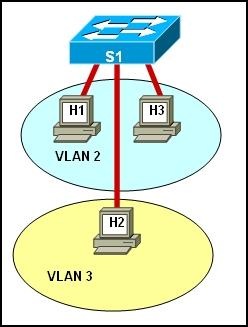
Refer to the exhibit. Which IP addressing scheme would be correct for the network?
• H1-172.18.0.10/16
H2-172.18.0.11/16
H3-172.18.0.12/16
• H1-172.18.0.10/16
H2-172.19.0.10/16
H3-172.18.0.11/16
• H1-172.18.0.10/16
H2-172.18.0.11/16
H3-172.19.0.11/16
• H1-172.18.0.10/16
H2-172.19.0.11/16
H3-172.19.0.11/16
29. 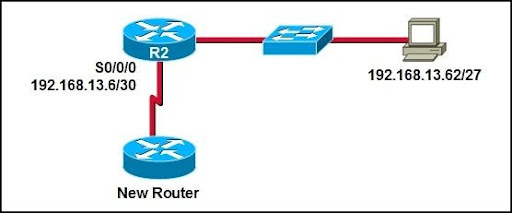
Refer to the exhibit. An administrator is adding a new router to the network. The IP address 192.168.13.6/30 has been assigned to the connecting serial interface on R2. What IP address must the administrator assign to the serial interface of the new router?
• 192.168.13.4/30
• 192.168.13.5/30
• 192.168.13.7/30
• 192.168.13.58/30
• 192.168.13.61/27
• 192.168.13.63/27
30. After comparing a previous baseline to current network statistics, the network engineer has discovered a significant increase in unwarranted traffic to the extranet. Which two steps simplify administration and control the unwanted traffic? (Choose two.)
• define an ACL at the distribution layer to isolate packets
• add an ACL at the router in the enterprise edge to block the traffic
• deploy a Layer 3 switch to contain broadcasts
• connect remote locations directly to the intranet
• configure all hosts with the same default gateway to eliminate unnecessary broadcasts
• deploy one core ISP router to reduce the delay in path determination
Minggu, 06 September 2009
CCNA Discovery 3 - FINAL Exam Answers V.4 #21-25
21. 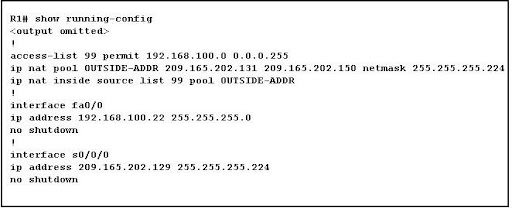
Refer to the exhibit. R1 is connected to the Internet through its serial 0/0/0 interface. Hosts on the 192.168.100.0/24 LAN on R1 cannot communicate with hosts on the Internet. What two NAT configuration issues might explain this failure? (Choose two.)
• The ip nat pool command has not been applied correctly.
• The inside interface has not been defined on R1.
• The access list does not include the group of IP addresses that are supported by the inside network.
• The ip address that is assigned to the serial 0/0/0 interface is incorrect
• The outside interface has not been defined on R1.
22. 
Refer to the exhibit. R1 and R2 are connected via serial interfaces. Both interfaces show that there is Layer 2 connectivity between them. The administrator verifies that CDP is operational; however, pings between the two interfaces are unsuccessful. What is the cause of this connectivity problem?
• no set loopback
• incorrect subnet mask on R2
• incompatible bandwidth
• incorrect IP address on R1
• incompatible encapsulation
23. Which two statements describe how the information contained in a BPDU is used by a switch? (Choose two.)
• to set the duplex mode of a redundant link
• to activate looped paths throughout the network
• to determine the root bridge
• to prevent loops by sharing routing tables between connected switches
• to determine which ports are placed in forwarding mode
24. When MD5 authentication is used for OSPF routing protocol authentication, what two facts are known about the key? (Choose two.)
• The key passes between routers in plain text.
• The key is used to help generate an encrypted number for authentication.
• The key passes between routers in encrypted form.
• The key is never transmitted.
• The key can be captured by using a packet sniffer.
25. 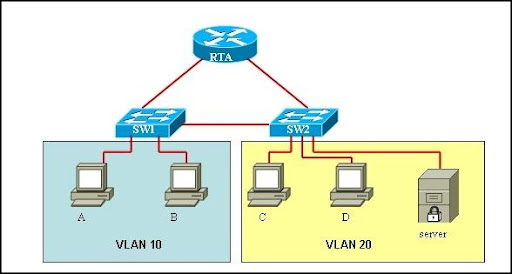
Refer to the exhibit. If router RTA fails, which statement is true?
• Hosts A and B can reach each other, but cannot reach hosts C and D or the server.
• No host can reach any other host.
• Hosts A, B, C, and D can reach each other, but cannot reach the server.
• All hosts can reach each other.
Sabtu, 01 Agustus 2009
Routing Components
Routing involves two basic activities: determining optimal routing paths and transporting information groups (typically called packets) through an internetwork. In the context of the routing process, the latter of these is referred to as packet switching. Although packet switching is relatively straightforward, path determination can be very complex.
Langganan:
Postingan (Atom)